
Emergency Tree Removal
Trees Can Grow Around Obstacles: What This Means for Tree Health
February 26, 2025
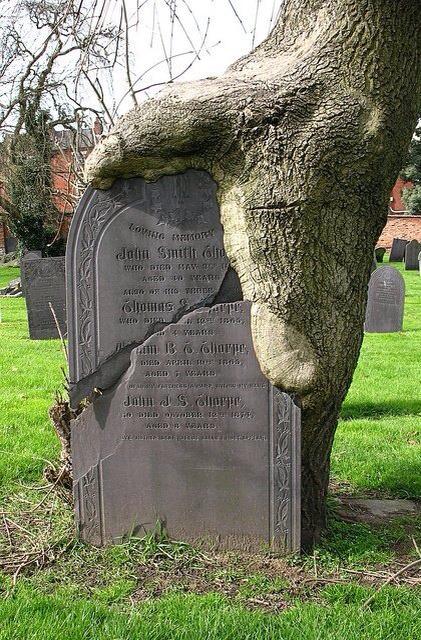
Walk through an old backyard, a wooded trail, or even a forgotten fence line, and you might spot something surprising — a tree trunk swallowing a metal post, roots weaving through concrete, or branches bending dramatically toward a sliver of sunlight. Trees don’t just grow upward; they adapt, adjust, and sometimes even “work around” whatever stands in their way.
These fascinating growth patterns aren’t just visually interesting; they’re a powerful reminder of resilience in nature. Unlike humans, trees can’t pick up and move when something blocks their path. Instead, they respond in subtle but persistent ways, gradually shaping themselves around obstacles over time. But while this adaptability is impressive, it also raises important questions about tree health, safety, and maintenance, especially when human-made objects are involved.
Let’s take a closer look at how trees grow around obstacles, what it means for their health, and how you can help your trees thrive in any environment.
How Trees Adapt to Their Environment
Trees are incredibly responsive organisms, constantly adjusting to their surroundings. Take, for example, phototropism. This is the process by which plants grow toward light. If a tree is partially shaded by a building, another tree, or even a fence, it will gradually lean or stretch its branches toward the available sunlight. The same principle of adaptability applies when a tree encounters a physical barrier.
The trees’ cell division and growth are always ongoing, and plant tissue can flow around, engulf, and bind to foreign objects, with an end result that is quite strong. The tree roots are covered in small hairs that are able to detect whether or not a tree can continue growing in a certain direction. According to ScienceDaily, “A protein at the tip of root hairs called RHD2 produces free radicals that stimulate the uptake of calcium from the soil. Calcium then stimulates the activity of RHD2, producing more free radicals and further uptake of calcium. When an obstacle blocks the hair’s path, the cycle is broken and growth starts in another location and direction.” In this way, tree roots are able to detect obstacles and maneuver around them.
This response is essentially stress avoidance, as the tree grows to avoid deficits in moisture or light, temperature extremes, and obstructions. Roots behave similarly underground, navigating around rocks, pipes, and foundations in search of water and nutrients.
While this adaptability is a sign of a tree’s strength, it also highlights how sensitive trees are to their environment. Even small changes, like placing an object too close to a trunk, can influence how a tree grows over time.
Common Objects Trees Grow Around
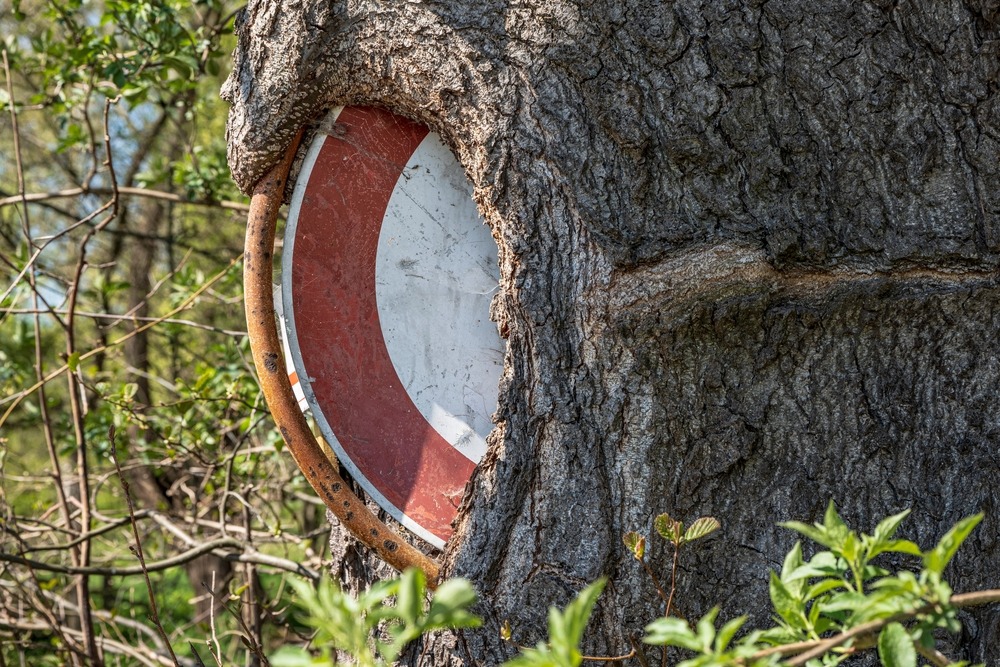
If you’ve spent time outdoors, you’ve probably seen trees growing around unexpected items. Some of the most common include:
- Fences: Trees planted too close to property lines often grow around metal or wooden fencing as they expand.
- Signs and Nails: Old signage, birdhouses, or even forgotten nails can become embedded in a tree’s trunk over time.
- Wires and Cables: Clotheslines, support wires, or electrical lines can become engulfed if left in place too long.
- Garden Décor: Decorative items placed near a tree can unintentionally become part of its structure.
- Rocks and Hardscaping: Roots may grow around or under patios, walkways, and retaining walls.
Is It Safe for Trees to Grow Around Obstacles?
Trees that grow around objects can look interesting and even artistic, but it begs the question: is it healthy? The short answer is: it depends.
In some cases, trees can grow around small, non-invasive objects without significant harm. However, several potential risks must be considered:
- Structural Weakness: Objects embedded in the trunk can disrupt the tree’s natural growth pattern, potentially creating weak points.
- Restricted Growth: Tight objects like wires or chains can constrict the tree as it expands, leading to damage or reduced nutrient flow.
- Increased Risk of Disease: Any foreign object can create openings in the bark, making it easier for pests and pathogens to enter.
- Hidden Hazards: Metal objects inside a tree can pose serious risks during pruning or removal, especially when using chainsaws.
Even if a tree appears healthy, internal damage may not be visible from the outside. That’s why it’s important to monitor any unusual growth patterns and avoid placing objects near trees in the first place.
When to Call a Professional Arborist
While some situations may seem harmless, there are times when professional intervention is the safest option.
You should consider calling an arborist if:
- A tree is growing around a tight or restrictive object, such as a cable or chain.
- You notice cracks, splits, or unusual bulging near the embedded object.
- The tree appears to be leaning excessively or showing signs of instability.
- There are signs of disease, such as discoloration, decay, or fungal growth.
- You’re unsure whether removing an object will harm the tree.
Arborists have the training and tools to assess the situation and determine the best course of action. In some cases, they may carefully remove the object or recommend structural support. In others, they may advise leaving it in place to avoid further damage. If the tree’s health or structural integrity has been compromised, it may be best to invest in a tree removal.
Help Your Tree Remain Resilient
Trees are remarkably resilient, but they still rely on proper care and a supportive environment to thrive. One of the simplest ways to protect your trees is to be mindful of what you place near them. Avoid attaching signs, hanging wires, or installing structures too close to the trunk, and regularly inspect your property for anything that could interfere with natural growth.
Routine maintenance also plays a key role. Tree pruning, rootwork, soil care, and regular health inspections can help your trees continue to grow strong and stable, even when faced with environmental challenges.
If you’ve noticed a tree growing around an object or showing unusual growth patterns, it’s worth having it checked by a professional. The team at All About Trees can provide expert evaluations, identify potential risks, and recommend the best solutions to keep your trees healthy for years to come. Contact us today to determine your next steps!